
This article specifies and discusses the four pillars which determine food security status or levels. The article defines theavailability of food, accessibility to food, affordability of food and the utilisation of food as the four pillars of food security. We finally explain how each of these pillars influences food security.
The four Pillars
Food security is achieved in four fundamental ways, which are referred to as the four pillars of food security. These pillars are Availability, Accessibility, Affordability, and Utilisation, and they work together to ensure that all individuals have reliable access to sufficient, safe, and nutritious food to maintain a healthy life.
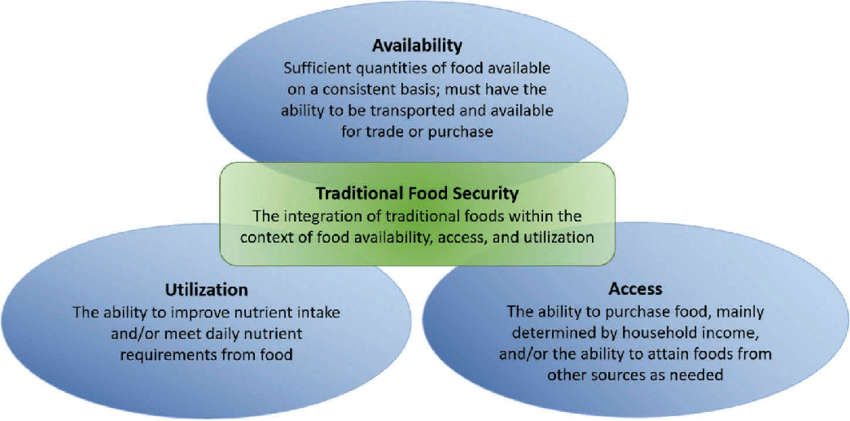
Availability refers to the physical existence of food, which depends on agricultural production, the stability of food supplies, and storage capabilities.
Accessibility, on the other hand, addresses the ability of individuals to obtain food regularly, taking into account factors such as infrastructure, transportation, and economic resources.
Affordability focuses on the economic aspect, ensuring that individuals and families have the financial means to purchase food without compromising other essential needs.
Lastly, Utilisation emphasizes the importance of proper food preparation and consumption practices, which are crucial for maximizing the nutritional value of the food consumed and ensuring that individuals can lead healthy lives. Together, these four pillars form a comprehensive framework for understanding and achieving food security globally.
Availability
Availability refers to the supply of food at national, district, community, and household levels which is assessed in relation to the corresponding requirements or demand for the food. Food security Availability is achieved when the supply of food is equal to or more than the demand for food. National food supply and requirements are measured in kilocalorie equivalent. This corresponds to the amount of energy that is obtained by a human being from a given quantity of food.
The availability or supply of food mainly depends on agricultural production, carry-over stocks, food gifts/aid, commodity exchange and trade. Agricultural food production for a given year is the main source of food supply for a country such as Zambia. Food crop production in turn is determined by productivity levels or yield rates (quantity produced per hectare) and area (hectarage) cultivated to food crops.
Food productivity is low in Zambia, particularly among small-scale farmers. This is caused by various factors such as reliance on single-season rain-fed agricultural production; low and inappropriate technology use; poor extension
services; high production costs resulting from high input costs; labour constraints; livestock and crop pests and diseases; poor agricultural and fisheries resource management practices which diminish the productivity of the
resource base. Overall agricultural production has also been negatively affected by low investment in the agriculture sector; inadequate finance and high cost of finance or credit.
While most of the above factors affect food supply at the national level, there are also supply constraints at the household level. These include household food production levels and productivity, family labour constraints (mostly due to poor health and effects of HIV/AIDS), low household resource base including farm implements and inputs, size and structure of households, and gender and age of household heads.
Diversification in Zambian agriculture has not been effectively pursued. Food production has highly focused on crop production at the expense of livestock and fisheries production. Even within crop production emphasis has been for support towards maize production with very little support to other food crops such as cassava, millet, sweet potatoes, sorghum, pumpkins, beans, groundnuts and rice. This is attributed to the fact that Zambian consumers have a stronger preference for maize Nshima relative to other food commodities.
When there is a maize deficit pressure is brought to bear on Government to spend millions of dollars to procure maize imports. In order to address this problem Government needs to offer tax incentives and other market support
incentives towards marketing and consumption of other food commodities such as cassava, millet, sweet potatoes, sorghum and rice as well as beans, groundnuts pumpkins, fruits, beef, poultry, fish and vegetables. Food crop diversification is important for ensuring that aggregate food supply at the national level meets the food security requirements at the community and household levels.
Accessibility
Accessibility refers to the fact that food should not only be available but be within reach of households and their individual members. Road and storage infrastructure, as well as other logistical arrangements, must be put in place to ensure timely movement and supply of basic food items to district and community market centres. The food that is available must be within reach of households.
Food accessibility implies physical and economical ability to obtain adequate and nutritious food, Food accessibility is influenced by social, economic and physical factors such as human health, food prices. and distance to food sources (markets).
The functioning of food markets or trade systems and information flow is important in accessing food. Income is another critical factor that determines access to food. Physical infrastructure, like availability and state of road networks, telecommunication infrastructures, as well as district and community market structures and distance to these market centres play an important role in influencing access to food. Social factors or social safety nets such as welfare payments arid social protection, cash remittances including pensions and transfers for the aged, sick, young and other vulnerable social groups also influence access to food.
Affordability
Affordability refers to the fact that food that is available and accessible should be priced at levels that are affordable to the majority of the population. This pillar of food security has an income and poverty dimension entailing that the
majority of the population must be at income levels that enable them to access basic foodcommodities.
The poverty datum line, income levels and the price of a standard food are critical yardsticks mechanisms for determining the proportion of the population that has the capacity to afford food. Assets are an important resource base in food mechanisms in times of critical financial difficulties or low food production. Assets facilitate access to food through direct and indirect conversion to food. Disposal of assets through trade or barter is a common coping
mechanism used by households to enable them to afford food. Employment creation, income generation and savings build the capacity of households to afford food.
Utilisation
The Utilisation pillar addresses the nutritional requirements of the population. Emphasis is placed on enhancing health conditions to ensure individuals possess bodies capable of effectively absorbing and utilizing food nutrients. The food provided must also meet the appropriate type and quality standards to satisfy the nutritional needs of human bodies, thereby enabling individuals to lead normal, healthy, and active lives. This necessitates an increase in the diversity of staple foods and consumption patterns at both national and household levels.
There is a direct relationship between food security and health and nutrition. Poor health and malnutrition are among the main results of food insecurity and this has been confirmed through empirical evidence not only in Zambia but also in other parts of the world. Food security is, therefore, a critical factor in promoting good health and nutrition.
On the other hand, good nutrition, hygiene and health care practices can enable food insecure households to obtain access to a more balanced diet and get more nutritional value from the foods they consume. The food utilization component entails the need to promote food processing and value addition to facilitate the effective absorption of food nutrients by human bodies.
Discover more from Decroly Education Centre - DEDUC
Subscribe to get the latest posts sent to your email.