
The writing process, as a pedagogical concept, shifted scholarly attention from finished texts to the composing activities of writers. Originating in research such as Janet Emig’s The Composing Processes of Twelfth Graders (1971), the term emphasizes that writing is not a single, instantaneous act of inspiration but an extended, recursive set of practices that takes an idea from conception to public presentation. This perspective underpins contemporary composition instruction: by dissecting writing into learnable stages, educators can teach strategies that demystify authorship, cultivate deliberate technique, and enable writers to produce clear, purposeful work.

Although many models exist, a widely adopted framework identifies five principal steps: prewriting, drafting, revision, editing, and submittal (publishing). These phases are neither strictly linear nor universally required in identical measure for every text. Rather, they constitute a flexible, recursive process that skilled writers navigate repeatedly and selectively according to context, genre, audience, and purpose. The following exposition examines these five steps in depth, situating them within the broader concerns of motivation, audience awareness, topic selection, research, organization, and the developmental acquisition of writing skills.
Prewriting: Purpose, Audience, and Preparation
Prewriting encompasses the activities that precede the first full draft. Its importance cannot be overstated: effective prewriting clarifies purpose, identifies audience, and organizes the writer’s resources so that the drafting phase proceeds with direction and efficiency.
Core elements of prewriting
Motivation and audience awareness.
Successful composition begins with an explicit understanding of what the writer intends to accomplish and for whom. Writers must determine their communicative purpose (to inform, persuade, narrate, examine, or entertain) and adapt tone, evidence, and structure accordingly. For students and novice writers, cultivating a sense of real audience—beyond the teacher’s grade—enhances motivation and produces work of higher rhetorical sophistication. Activities such as presenting drafts to peers, posting work for broader readership, or writing toward a public venue (e.g., a blog or letter to an editor) help develop authentic audience awareness.
Topic selection and narrowing.
Choosing an appropriate topic requires balancing interest, significance, and scope. Oral storytelling, brainstorming, and freewriting are traditional ways to surface promising ideas; freewriting allows unfiltered generation of material, while quick oral retellings can reveal which topics hold narrative or analytic potential. Equally important is focusing or narrowing: a topic that is too broad resists meaningful coverage within constraints of length or assignment. Writers should identify a manageable angle or question that can be treated convincingly in the available space.
Gathering information
Prewriting often entails research—consulting primary and secondary sources to amass facts, perspectives, and evidence. Research may be informal (conversing with knowledgeable people, reviewing notes) or formal (library and database searches, archival work). Organizing source material early—through annotated bibliographies, note cards, or digital folders—facilitates later citation and prevents redundancy. For personal or reflective genres, gathering may instead mean assembling memories, sensory details, and descriptive observations.
Organizing content
outlines, diagrams, and mind maps. Structuring material before drafting is a practical way to sequence ideas and ensure coherence. Techniques include linear outlines, visual storyboards, clustering (mind maps), and index-card sequencing. Each method highlights relationships among ideas—hierarchy, chronology, cause-effect, comparison—allowing the writer to choose the organizational pattern best suited to purpose and audience.
Drafting: Translating Planning into Prose
Drafting is the act of converting prewriting plans and research into continuous prose. The objective of an initial draft is to produce a complete articulation of the writer’s main ideas, not to achieve perfection on first attempt.
Principles and practices of drafting
- Emphasize flow over finish. Writers should prioritize sustaining the logical progression of ideas rather than obsessing over sentence-level precision. Early drafts are instruments for discovery: gaps become evident, new connections emerge, and unanticipated problems surface.
- Use structured flexibility. Although prewriting supplies structure, drafting may reveal the need for reorganization. Writers who treat outlines as hypotheses—provisional structures to be tested—can respond productively to insights arising during composition.
- Maintain local clarity to support global coherence. While holistic revision will address macrostructure, paying attention to paragraph unity and topic sentences during drafting reduces the scale of later restructuring. Each paragraph should develop a single main idea and link visibly to adjacent paragraphs.
- Allow multiple drafts. A single draft rarely suffices. Subsequent drafting cycles refine thought, improve transitions, and elaborate evidence. Writers should expect drafting to be iterative, with each pass advancing clarity and rhetorical effectiveness.
Revision: Re-seeing and Reworking Content
Revision differs from editing in scope and intent. Where editing concerns surface correctness and conventional expression, revision engages substantive rethinking: reorganizing, expanding or contracting content, refining argumentation, and strengthening rhetorical effect.
Key facets of effective revision
- Macro-level reorganization. Revision often begins by evaluating structure: Is the thesis explicit and compelling? Do sections proceed logically? Is evidence appropriately placed and proportioned? Reordering paragraphs, consolidating redundant passages, or excising irrelevant material are common macro-revisions.
- Strengthening argument and coherence. Revision addresses whether claims are sufficiently supported and whether reasoning proceeds persuasively. Writers should test claims against counterarguments, provide empirical or textual support as needed, and deploy illustrations that clarify abstractions.
- Enhancing style and clarity. Revision attends to diction, sentence variety, and rhythm. This is the stage to sharpen language, eliminate clichés, and ensure that syntactic choices serve clarity and tone.
- Seeking external feedback. Revision benefits enormously from outside readers. Peer review, tutor consultations, and mentor comments reveal blind spots that the writer cannot perceive alone. Responding to substantive critique can require substantial rewriting; such effort is central to the improvement of one’s work.
- Recursion across stages. The revision stage may prompt additional research or further prewriting; the process is recursive rather than linear. Recognizing this circularity permits flexible allocation of effort where it will yield the greatest improvement.
Editing: Fine-Tuning Conventions and Presentation
Editing performs the quality-control function that prepares a manuscript for readership. It targets grammar, mechanics, formatting, and stylistic consistency, ensuring that the document adheres to conventions appropriate for its genre and audience.
Practical editing strategies
- Proofreading for conventions. Careful attention to grammar, punctuation, spelling, and sentence structure prevents distracting errors. Editing tools and style guides (e.g., APA, MLA, Chicago) are useful references, but writers should not rely on automated corrections as substitutes for careful reading.
- Consistency and citation. Editing includes verifying references, ensuring accurate citations, and maintaining consistent formatting of headings, captions, and lists. For academic and professional writers especially, correct citation avoids plagiarism and enhances credibility.
- Read-aloud and backward reading techniques. Reading the text aloud reveals awkward phrasing and rhythm problems; reading sentences in reverse order helps isolate typographical errors and small mechanical mistakes.
- External editing. Having another competent writer or editor perform a final review offers significant advantages. A fresh reader more readily notices errors and can judge the effectiveness of argument and clarity of exposition.
Submittal (Publishing): Sharing Work with an Audience
The final stage—submittal or publishing—encompasses the dissemination of writing. Publication can take many forms: formal submission to journals or presses, posting online, distributing printed materials, or oral presentation. The act of making writing public completes the communicative cycle and invites larger audience response.
Considerations for effective submittal
- Selecting the appropriate venue. The choice of outlet influences formatting, tone, and expectations for documentation. Writers should research prospective journals, publishers, or platforms to ensure alignment with their subject matter and intended readership.
- Final checks for presentation. Before submission, verify that all formatting, pagination, and supplementary materials (cover letters, abstracts, figures) conform to submission guidelines.
- Reflecting on audience response. The publication stage also begins a new cycle of feedback: reviews, comments, and reader interaction provide material for future revision and growth.
Developmental Acquisition of Organizing Skills
Writing competence develops through progressive acquisition of organizational strategies. Young or inexperienced writers may first produce work that is descriptive and episodic; with instruction and practice, they learn to impose larger organizing principles—chronology, cause-effect, problem-solution, comparison—on their material. Teachers and mentors can scaffold this progression by modeling organization explicitly, providing templates and heuristics, and offering targeted feedback on structure.
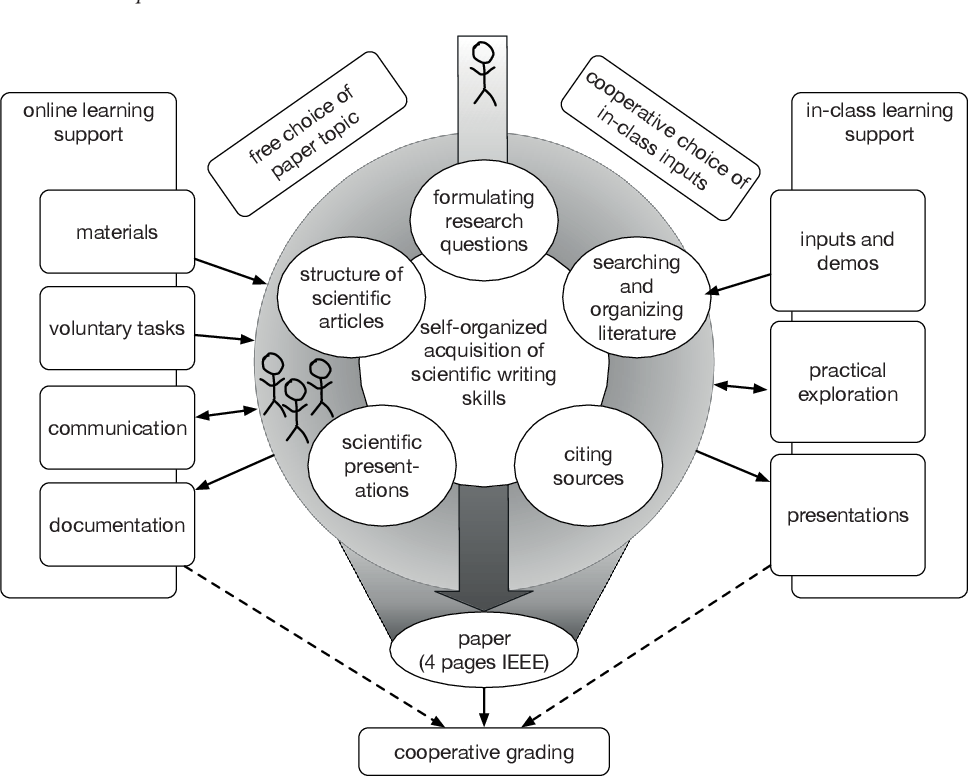
Pedagogical approaches that foster organizational skill include:
- Explicit instruction in rhetorical patterns and when each is most appropriate.
- Guided practice in outlining, paragraphing, and transitional phrasing.
- Analysis of model texts to identify and emulate effective structural choices.
- Incremental complexity in assignments, encouraging gradual mastery of multi-part arguments and research integration.
Writing Trials, Recursion, and Variables
The writing process is highly variable. Different genres, audiences, time constraints, and individual preferences produce divergent processual patterns. Some writers prefer extended prewriting; others produce a rough draft quickly and then revise extensively. Professional writers may integrate research and drafting in alternating cycles; students under deadline may compress stages. Recognizing the variability of writing processes relieves prescriptive pressure and allows writers to adopt and adapt practices that best support their goals.
Recursion—the practice of revisiting earlier stages—is a hallmark of skillful composition. For example, a writer may discover during revision that additional research is required, or they may return to prewriting to reframe their thesis. Embracing recursion as a normal and productive condition empowers writers to produce work that is more thoughtful and well-constructed.
Practical Tips for Applying the Five-Step Process
- Begin with focused prewriting. Spend sufficient time clarifying purpose, audience, and scope. A half-hour of concentrated planning often saves many hours later.
- Draft without excessive self-censorship. Allow the first draft to be exploratory; aim for completeness rather than polish.
- Use revision to re-see the work. Consider objective questions: What is my central claim? Is each section necessary? Does the evidence convincingly support my claim?
- Reserve editing for final correctness. Avoid conflating stylistic polishing with substantive revision; they are distinct tasks requiring different mindsets.
- Choose publication venues carefully and attend to their conventions. Treat submission as the culmination of a disciplined process, not merely an afterthought.
Conclusion
Conceiving of writing as a sequence of interrelated, teachable stages transforms the act of composition from an enigmatic burst of inspiration into a disciplined craft. The five-step model—prewriting, drafting, revision, editing, and submittal—offers a practical scaffold for writers at all levels. It does not prescribe a rigid order but rather delineates categories of activity that, when repeatedly practiced and adapted, produce reliable improvement. By attending to motivation, audience, careful topic selection, thoughtful research, and systematic revision, writers produce work that is not merely correct, but purposeful, clear, and impactful. The recursive nature of the process invites continual refinement of skill: each completed piece becomes a laboratory for learning, and each subsequent composition benefits from the accumulated insight of prior experience.
Discover more from Decroly Education Centre - DEDUC
Subscribe to get the latest posts sent to your email.